
There is no safe one-number answer to the Tailsos USB download size question for every release and every drive. Start with the capacity shown by the current official Tails installer, then select a drive whose usable capacity is comfortably above that value. Remember that manufacturers advertise decimal capacity, operating systems report space differently, and a Tails layout can make a working USB look smaller or unusual. A larger, dedicated drive is the safer choice when you need Persistent Storage, repeated testing, or a backup installer.
What the Tailsos USB download size question is really asking
A search for Tails USB size can refer to three different measurements: the download file size, the minimum usable capacity required by the installer, or the free space you want after the boot media is created. They are related but they are not interchangeable. The download may fit on a drive that still leaves too little room for the partition layout or supported Persistent Storage features. Conversely, a drive can display a large package number while exposing less space to the operating system.
- Separate image size, required capacity, and spare working space.
- Check the current official requirement immediately before writing the drive.
Advertised capacity versus usable USB space
USB packaging normally uses decimal units: a drive sold as a particular number of gigabytes is measured in powers of ten. Operating systems often display a binary-style value or reserve space for partition metadata and controller functions, so the number in File Explorer, Finder, or a disk utility can be lower. This difference is expected and does not automatically indicate a fake or damaged drive.
- Compare the device's total capacity in a disk utility, not just a mounted folder.
- Expect a modest difference between the package label and the operating-system report.
How much headroom should you plan?
Use a simple three-part decision. First, meet the current official requirement for the image you will write. Second, leave practical headroom so a small reporting difference, a later update, or the writer's temporary work does not make the device borderline. Third, add more capacity only when it solves a real need, such as supported Persistent Storage, a second test image, or a recovery plan. Buying a larger drive does not make incompatible hardware compatible and does not replace verification.
- Test drive: official requirement plus visible spare capacity.
- Regular drive: additional headroom for updates, verification, and a realistic session.
Check the physical capacity before writing
The safest check is the device-level capacity shown by the operating system before you select a target. Disconnect unrelated removable media, identify the USB by its connector, manufacturer, approximate size, and port, and compare those details with the disk list. A drive letter or a short name can change; the physical device and its capacity provide stronger evidence.
- Unplug other flash drives, cards, phones, and hubs when possible.
- Compare the disk's total size with the USB in your hand.
Capacity is not the same as drive quality
A drive can have enough reported space and still be a poor boot medium. Counterfeit flash drives sometimes advertise a large capacity but fail when the data reaches the hidden limit. Worn memory may disconnect, become read-only, or pass a quick write and fail later. A larger label does not compensate for unstable hardware.
- Replace media that reports wildly different capacities or repeated write errors.
- Test a new drive with a complete write, verification, and cold boot.
Persistent Storage changes the planning question
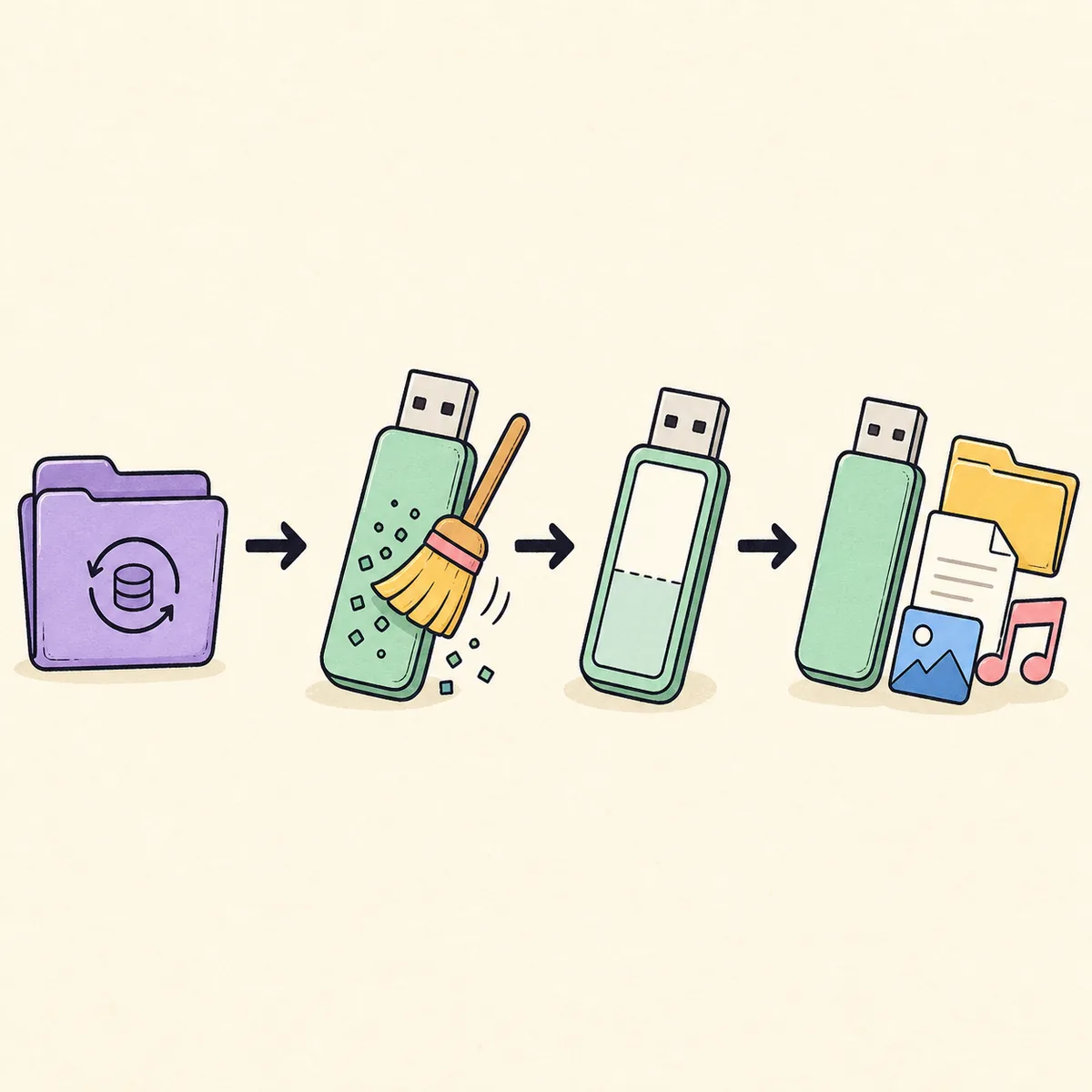
A bootable Tails USB and a USB with Persistent Storage have different planning needs. Persistent Storage keeps only the supported features you choose, and the space consumed depends on your files and settings. It is not a substitute for a backup and it does not turn a removable session into a conventional installed operating system.
- Reserve space based on your real supported data, not a guessed universal number.
- Verify the first boot before configuring Persistent Storage.
A safe Tails USB capacity workflow
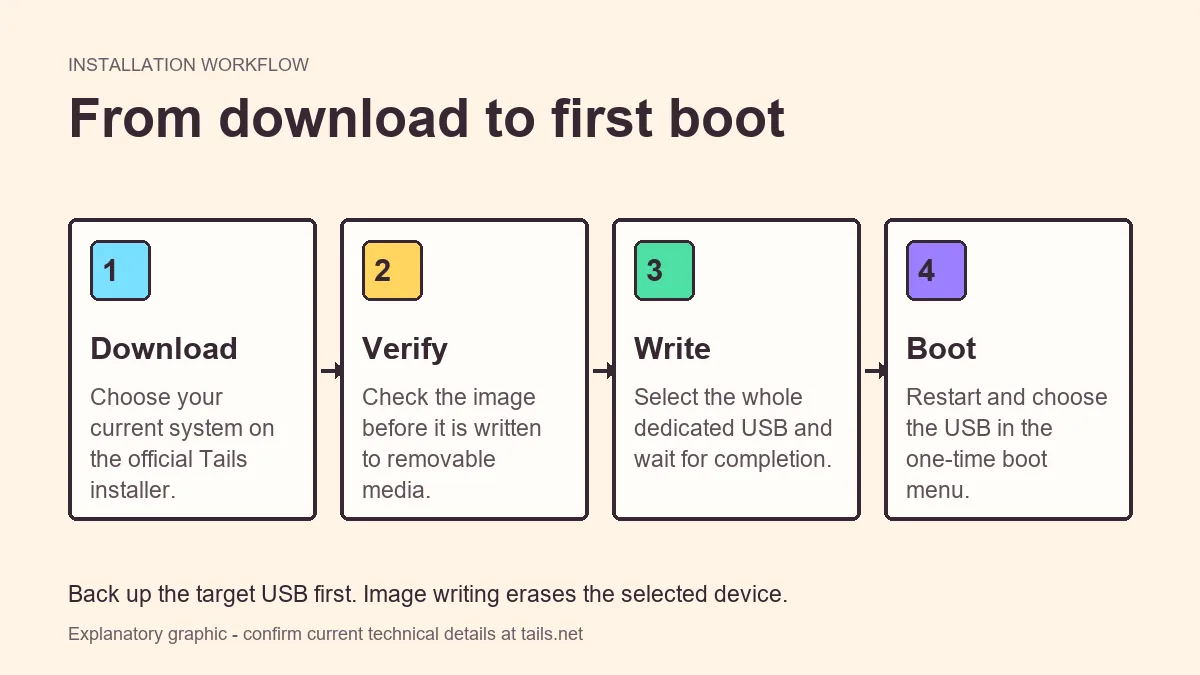
Use this order whenever you prepare a new drive: open the current official Tails download page, note the requirement for the image and platform, compare it with the usable capacity of a dedicated USB, back up the target, download and verify the file, write it to the whole device, and test a cold boot. If any value is unclear, stop at that step instead of filling the gap with an old blog post or a search advertisement.
- Official requirement checked on the day of preparation.
- Usable device capacity compared with comfortable headroom.
What this page cannot promise
No USB capacity guarantees anonymity, security, compatibility, or data recovery. Tails can help supported applications use Tor and can reduce local traces, but accounts, documents, firmware, networks, external services, and user choices still affect privacy. A verified image proves provenance and integrity for that file; it does not prove that every hardware or operational risk is solved.
- Do not treat a retail label as the official requirement.
- Do not format a working Tails USB just because a desktop cannot read its partitions.
Use a repeatable Tailsos USB download size check
The useful result is not a magic gigabyte number. It is a drive whose usable capacity exceeds the current official requirement, whose target was identified before writing, and whose first boot was tested on the computer you plan to use. This approach accounts for decimal versus binary reporting and for the unusual partitions a working Tails device may expose.
If you need Persistent Storage, plan the files and supported features first, keep a separate backup, and leave more room than a bare installation needs. If you only need a compatibility test, a reliable dedicated drive with visible headroom is usually simpler. In both cases, verify the source before you write and do not let a stale page decide the target.
Recheck tails.net after a release or a hardware change. The official installer is the place to confirm current image details, capacity requirements, verification steps, and known issues. This independent guide explains the decision so you can read that source carefully; it does not host or modify Tails images.
- Current official requirement checked.
- Usable capacity compared with headroom.
- Target device and backup confirmed.
- Image verified before writing.
- Boot and recovery tested on the real computer.
Tailsos USB download size FAQ
What is the Tailsos USB download size?
The download file size and the USB capacity requirement are different. Use the current official Tails installer for the authoritative requirement, then choose a drive with comfortable usable headroom.
How much space does Tails need on a USB stick?
For the Tailsos USB download size, check tails.net immediately before writing because the requirement can change with the image and supported workflow. Do not substitute an old fixed number or the capacity printed on the package.
Why does my USB show less space than the label?
Manufacturers use decimal capacity, operating systems report units differently, and partition metadata reserves or hides some space. A modest difference is normal; a wildly wrong value can indicate a failing or counterfeit drive.
Does a larger USB make Tails compatible with any computer?
No. Capacity does not change processor architecture, firmware, graphics, Wi-Fi, or other hardware limits. Check the current official requirements and test the exact computer.
Do I need extra space for Persistent Storage?
Plan room for the supported features and files you will actually use, then keep a separate backup. Persistent Storage is optional and is not a universal extra-space requirement.
Can I format the USB if it looks smaller after writing Tails?
Do not format it until you know that you no longer need Tails or Persistent Storage. The partition layout can look unusual while the drive still boots; test it and use the official troubleshooting path first.
Is the biggest USB always the safest choice?
No. Reliability, source verification, hardware compatibility, and a tested backup matter as much as capacity. An unusually large but unstable or counterfeit drive is a poor boot medium.
Where should I verify the current USB requirement?
Start at the official Tails download and installation instructions on tails.net. This site is an independent guide and does not host, repackage, or replace the official image.
Technical facts and downloads should be confirmed against the Tails official download and installation instructions. This independent guide does not host or modify Tails images.